
 Saurabh Mukherjee

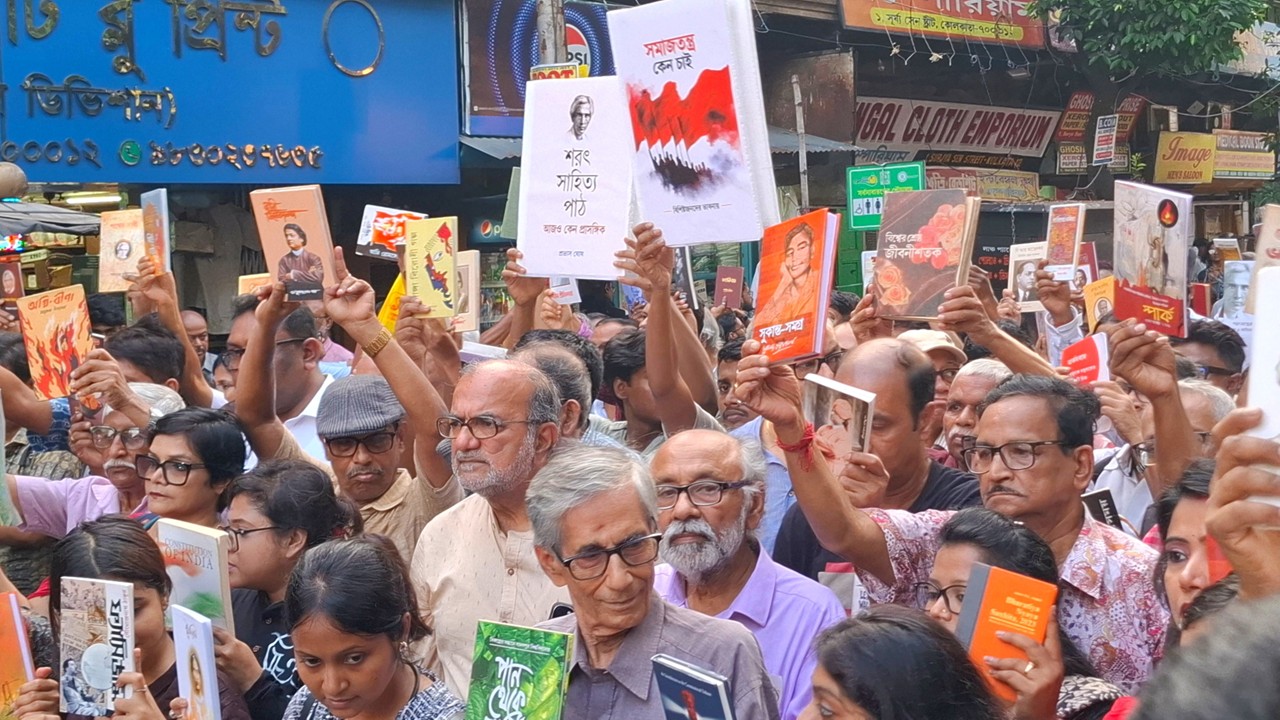
Thousands of people took to the streets of Kolkata on Saturday (October 31) in a march defending books and reading, protesting the attempts to demolish bookstalls during Durga Puja. Carrying books, banners and posters, the participants turned the rally into a public assertion against what they described as an attack on the freedom to read and the city’s intellectual culture.
“Books versus Bulldozer” read several banners held by the marchers. Another slogan drew on the Bengali words porun (read) and poran (burn), urging people to “Boi porun” (read books) rather than burn them.
Many participants described themselves as “Dimagi Naxals”, while others said the sight of young people marching alongside older generations was “bound to strike fear among the powers-that-be”.
The books carried by the protesters reflected a wide range of political, literary and historical traditions. Ishwar Chandra Vidyasagar’s Barnaparichay, the primer through which generations of Bengali children learnt their letters, featured prominently.
Copies were held alongside a large poster of the original Constitution of India. An auto-rickshaw in the procession displayed Barnaparichay, The Communist Manifesto, posters of Ambedkar and Sarat Chandra Chattopadhyay’s Pather Dabi.
Young women carried Rabindranath Tagore’s Gora, a copy of the Constitution, a book on fascism and a biography of young revolutionary Khudiram Bose. Other participants brought Anne Frank’s The Diary of a Young Girl, Bhagat Singh’s Jail Diary and The Communist Manifesto.
 CPI(M) leader Bikash Ranjan Bhattacharya also the joined the porotest. Photo: X/@KanjilalSupti10
The march followed the demolition drive against Left bookstalls during Durga Puja by functionaries associated with the state’s new BJP government. While senior leaders defended the attacks on the stalls, lower-level party workers were accused of carrying out the campaign.
The attempts to remove the stalls had triggered resistance in several places. In Jadavpur, hundreds of people stood in front of an earthmover to stop it from demolishing a bookstall. The controversy also brought visitors to Left bookstalls who would not ordinarily have stopped there during the Puja festivities. The CPI(M) said it had recorded unprecedented sales of books.
A research scholar from Jadavpur University who joined Saturday’s march held Chief Minister Suvendu Adhikari’s “destructive call” ahead of Durga Puja responsible for encouraging the attacks.
“As a research scholar, books have always been close to my heart. It was not uppermost in my mind that a book stall set up by the CPM or SUCI or CPI(ML) was destroyed. What mattered to me was that books were desecrated and the state allowed that,” he told The Telegraph.
The confrontation in Jadavpur had continued through the night after police brought in a bulldozer to dismantle a bookstall. This happened on a night when 19 visitors were killed in a stampede at a Durga Puja pandal in north Kolkata, adding to the outrage over the administration’s handling of the bookstall dispute.
The procession began at the statue of Vidyasagar in College Square and circled the square before returning to its starting point.
Among those taking part was Pabitra Sarkar, 90, former vice-chancellor of Rabindra Bharati University, who said he had joined despite being unable to walk comfortably.
“I cannot walk any more. But I thought I should still protest this regressive culture. This protest is not about party politics. We cannot let Bengal become Nazi Germany,” he said.
Political scientist Maidu Islam also joined the protest, arguing that the attacks on bookstalls amounted to a violation of citizens’ fundamental rights. He described the march as “against the cowardly attacks on citizens who wanted to restrain the lumpens massacring books and bookstalls”.
At the end of the march, the protesters gathered once again around the garlanded statue of Vidyasagar, the social reformer who worked to make education and books accessible to ordinary people.
The books brought by the participants, ranging from Maxim Gorky’s Mother and Pather Dabi to Bhagat Singh’s Jail Diary, became a visible symbol of the resistance. The march brought together generations of readers in a collective protest against the destruction of bookstalls and what they saw as an assault on Bengal’s reading culture.
“Books versus Bulldozer” read several banners held by the marchers. Another slogan drew on the Bengali words porun (read) and poran (burn), urging people to “Boi porun” (read books) rather than burn them.
Many participants described themselves as “Dimagi Naxals”, while others said the sight of young people marching alongside older generations was “bound to strike fear among the powers-that-be”.
The books carried by the protesters reflected a wide range of political, literary and historical traditions. Ishwar Chandra Vidyasagar’s Barnaparichay, the primer through which generations of Bengali children learnt their letters, featured prominently.
Copies were held alongside a large poster of the original Constitution of India. An auto-rickshaw in the procession displayed Barnaparichay, The Communist Manifesto, posters of Ambedkar and Sarat Chandra Chattopadhyay’s Pather Dabi.
Young women carried Rabindranath Tagore’s Gora, a copy of the Constitution, a book on fascism and a biography of young revolutionary Khudiram Bose. Other participants brought Anne Frank’s The Diary of a Young Girl, Bhagat Singh’s Jail Diary and The Communist Manifesto.
CPI(M) leader Bikash Ranjan Bhattacharya also the joined the porotest. Photo: X/@KanjilalSupti10The march followed the demolition drive against Left bookstalls during Durga Puja by functionaries associated with the state’s new BJP government. While senior leaders defended the attacks on the stalls, lower-level party workers were accused of carrying out the campaign.
The attempts to remove the stalls had triggered resistance in several places. In Jadavpur, hundreds of people stood in front of an earthmover to stop it from demolishing a bookstall. The controversy also brought visitors to Left bookstalls who would not ordinarily have stopped there during the Puja festivities. The CPI(M) said it had recorded unprecedented sales of books.
A research scholar from Jadavpur University who joined Saturday’s march held Chief Minister Suvendu Adhikari’s “destructive call” ahead of Durga Puja responsible for encouraging the attacks.
“As a research scholar, books have always been close to my heart. It was not uppermost in my mind that a book stall set up by the CPM or SUCI or CPI(ML) was destroyed. What mattered to me was that books were desecrated and the state allowed that,” he told The Telegraph.
The confrontation in Jadavpur had continued through the night after police brought in a bulldozer to dismantle a bookstall. This happened on a night when 19 visitors were killed in a stampede at a Durga Puja pandal in north Kolkata, adding to the outrage over the administration’s handling of the bookstall dispute.
The procession began at the statue of Vidyasagar in College Square and circled the square before returning to its starting point.
Among those taking part was Pabitra Sarkar, 90, former vice-chancellor of Rabindra Bharati University, who said he had joined despite being unable to walk comfortably.
“I cannot walk any more. But I thought I should still protest this regressive culture. This protest is not about party politics. We cannot let Bengal become Nazi Germany,” he said.
Political scientist Maidu Islam also joined the protest, arguing that the attacks on bookstalls amounted to a violation of citizens’ fundamental rights. He described the march as “against the cowardly attacks on citizens who wanted to restrain the lumpens massacring books and bookstalls”.
At the end of the march, the protesters gathered once again around the garlanded statue of Vidyasagar, the social reformer who worked to make education and books accessible to ordinary people.
The books brought by the participants, ranging from Maxim Gorky’s Mother and Pather Dabi to Bhagat Singh’s Jail Diary, became a visible symbol of the resistance. The march brought together generations of readers in a collective protest against the destruction of bookstalls and what they saw as an assault on Bengal’s reading culture.


Comments (0)
Leave a Comment