
 Ana Vracar
Fiona Ben Chekroun, European co-coordinator of the BDS National Committee (BNC), recently visited Ljubljana, Rijeka and Zagreb, where she met with local Palestine solidarity groups and discussed Boycott, Divestment, Sanctions (BDS) campaigns in Slovenia and Croatia. Peoples Dispatch spoke with Ben Chekroun about changes and breakthroughs in this arena since the beginning of the genocide in Gaza in October 2023.
For the past 20 years, people around the world have responded to the BDS call launched by Palestinians to pressure Israel to comply with international law. “For me, it has always been very important to answer a Palestinian call, and that’s where I found my legitimacy and conviction that I was going in the right direction,” Ben Chekroun contextualized the call. “Because at some point, I’m answering to something coming from those who are oppressed and fighting, calling us to stand in solidarity by cutting all forms of complicity with the system that oppresses them.”
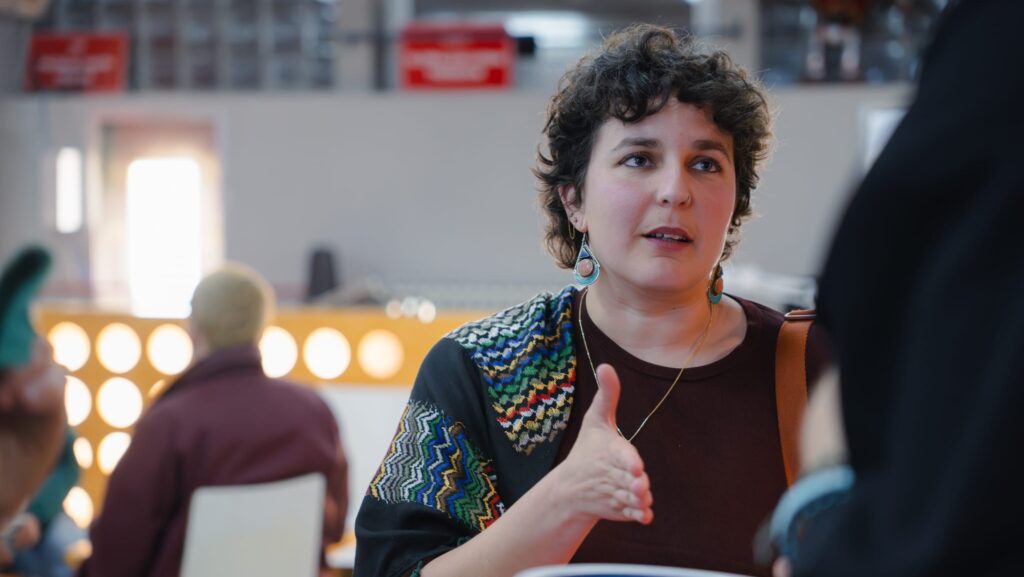 Fiona Ben Chekroun. Source: MAMA Zagreb/Facebook
Exponential Growth of Activities
Like the overall solidarity movement with Palestine in Europe – which has grown stronger and more vast over the past two and a half years – BDS activities have also expanded. Ben Chekroun refers to an “exponential growth”: meaning that not only is the BNC seeing groups take shape in places where they were not present before, but these groups are also larger in absolute numbers. While this comes with challenges, it has significantly strengthened campaigns.
This growth has led to an organic expansion of new campaigns. “The campaign on ethical tourism called ‘No room for genocide‘ is one of these examples,” Ben Chekroun says, referencing drives to deny passage to war criminals and boycott accommodation platforms that profit from Israeli occupation. “That was literally a campaign born during the genocide, with the determination to prevent war criminals from circulating and having holidays from genocide with total impunity.”
It has also led to more intersectional alliances, an aspect that Ben Chekroun emphasizes is of particular importance. “You can see more and more trade unions adopting BDS guidelines and joining calls to action, coordinating with grassroots BDS groups and partners,” she points out. The same can be said, she adds, for other justice struggles, including climate, LGBTIQI+, and peace groups. “The climate movement made the link between colonialism, climate destruction and genocide; that’s how they were able to join a campaign directly against insurance company AXA or banks with comparable links such as Barclays in Britain,” Ben Chekroun says. “And you can also see LGBTIQI+ groups marching under the slogan ‘No pride in genocide.'”
“In Spain, they’ve been able to build a very large intersectional campaign with trade unions, political parties, grassroots groups, feminist groups, queer groups, and part of the climate justice movement. It was very broad, reaching even people in villages. At one point, you had 150 cities and villages having demonstrations at the same time, bringing up the same demands. This requires not only a lot of organization and coordination, but also building trust among different components of the Spanish state, which is very challenging due to its own history.”
“BDS has become much more widely known,” she points out. “Before, it was somehow always about explaining, over and over again, to the mainstream. That’s still the case when it comes to the strategy, but the words boycott, divestment, and sanction have become more present in the mainstream. And that means we also reach some spaces we weren’t able to reach before.”
The Achievements of People-Power
In Europe, Ben Chekroun says, there have been numerous incremental wins – “that are maybe not full wins, but are big steps in the right direction” – thanks to intersectional alliances and a bigger presence in the mainstream. “It’s amazing to think that it’s people-power that brought us to Israeli military companies being kicked out of weapons fairs and to vessels being either denied to dock or having their cargo confiscated – like in Italy recently, with the MSC vessels transporting military-grade steel to Israel,” Ben Chekroun says. “You can see the steps happening, and that’s because of people-power.”
Incremental wins and the growth of people’s power can be observed across sectors: from academic boycott calls that led to encampments or decisions to ban Israeli participation in programs – even in non-pro-Palestinian spaces like the UK Royal College of Defence Studies – to sports, from labor to culture and energy. The list of examples Ben Chekroun outlines covers everything from an ongoing call, endorsed by thousands of musicians and artists, to boycott Eurovision over Israel’s participation, to advocacy campaigns for local administrations and companies to adopt ethical procurement policies that would prevent them from collaborating with entities complicit in human rights infringements: not only in Gaza, but across the world.
Another clear victory, she adds, has recently come when Italian energy giant ENI decided to withdraw from an Israeli gas exploration consortium. “It has never been legal, ethically, or morally grounded to invest in Israel. But now it’s also becoming financially reckless – because Israel, even if its economy had been resilient before, is now increasingly becoming what we at the BDS movement call a shutdown nation.”
“It’s important to always name Israel for what it is: an apartheid, genocidal, settler colonial regime. And today, it is increasingly perceived by the majority of the world as a rogue state. If we take a step back and look at the global picture, Israel has never been as isolated as it is today, as weak as it is today – although it might appear strong at the same time because it is still backed by US imperialism.”
“The West has shielded Israel from accountability for seven decades”
Other spaces that have come within reach over the past two and half years can also be found in institutional politics: talk of sanctions on Israel has become much more widespread, Ben Chekroun says, with Belgium, Slovenia and Spain taking steps to introduce a partial military embargo on the occupation power. Another thing the Palestine solidarity movement in Europe has been able to achieve is positioning Palestine as the center of political conversation and activity in the region.
But it goes even beyond that, according to Ben Chekroun, as colonialism has become a legitimate target too. “That’s something that Palestinians have been able to do: in resisting and surviving genocide and still being able to make sure that their narrative is pushed – and pushing the line of those very colonial racist spaces that before were just dismissing everything.”
The results of this trend have been multifold, Ben Chekroun says. The spotlighting of European complicity in the genocide has unmasked this particular brand of hypocrisy in the West, while raising awareness in the Global South that what is happening in Gaza could easily be replicated elsewhere in the world. “Colombian President Gustavo Petro said it quite early in the genocide: this is a test, and we’re next if we don’t stop it,” Ben Chekroun recalls. “We’re seeing these tactics now being used in Lebanon, and in Cuba too. I think there’s definitely a consciousness in the Global South that what’s happening in Gaza is a consequence of this deadly system of colonialism, capitalism, and imperialism at large.”
In Europe, the response has been different. On the one hand, Ben Chekroun points out, governments of the European core have been feeling the heat from solidarity movements. This pressure has pushed some countries to consider a different – tentatively more progressive – stand, as mirrored in the increased participation of countries in meetings of the Hague Group.
But this is far from a universal response. Other countries have tilted towards a more repressive tactic. “The West has shielded Israel from any form of accountability and supported the Israeli apartheid and settler colonial regime financially, economically, and diplomatically for seven decades,” she says. “In a way, we’re here today because of those policies, because the movement is responding to them. It has more space to do it [compared to other regions] – but at the same time, less and less space because the repression is growing as they see we’re able to shake the system.”
The crackdown on civil liberties we have been witnessing across Europe is a result of this, Ben Chekroun warns, adding that its impact will certainly not remain confined to Palestine solidarity.
Yet another outcome can be observed in Eastern Europe. “Sometimes people outside the region see Eastern Europe as a space where nothing can happen,” Ben Chekroun says, immediately countering that solidarity movements have been growing in this region as well. “These governments – in Hungary [PD note: the conversation took place before the inauguration of Peter Magyar’s administration], the Czech Republic, Romania, for example – are very much complicit. Elbit System, one of the biggest Israeli military companies, has settled in Romania.”
“It’s true that the context is very specific,” she adds. “The transition to capitalism has fragmented, diluted and destroyed the sense of community. Trade unions have been weakened, the politicization of people has also been weakened. So for us now it’s about how to connect these different things – the fight against corruption and democratic backsliding – with Palestine. Essentially, it’s about showing that if Elbit is coming to Romania, it’s because they’re feeling the heat in the western part of Europe, and that this company is bringing lots of corruption cases in its luggage.”
This brings the conversation back to building intersectional alliances, as Ben Chekroun emphasizes that Israeli and other complicit companies are following a well-established blueprint: they might be moving operations to avoid pressures, but they are also profiting from weaker labor protections in Eastern Europe. On top of that, governments in Eastern Europe are not losing time to emulate crackdowns on movements observed in the West. “They can also feel that movements are growing, and so we have seen recently in Poland, in Czechia, in Hungary and in Romania, a wave of repression and arrests of activists.”
Opportunities that Rise Amidst Darkness
The system is shaken and becoming more aggressive in response, Ben Chekroun says. “It will react even more violently – that’s part of the cycle. So it’s about being able to see the opportunities that rise amidst darkness. And I think Palestinians have [been doing that]. It’s been their reality for the last 78 years: how to find opportunities and how to find ways to fuel the resistance against this system and use what’s happening for fueling popular resistance.”
“This brings us back to the discussion of how Palestine will free us all: because it’s at the center of so many oppression systems, because it’s connecting so many justice struggles. It’s become the symbol of how to shut down fascism, how to shut down capitalism, patriarchy, and all of those systems that are oppressing everyone.”
Courtesy: Peoples Dispatch
For the past 20 years, people around the world have responded to the BDS call launched by Palestinians to pressure Israel to comply with international law. “For me, it has always been very important to answer a Palestinian call, and that’s where I found my legitimacy and conviction that I was going in the right direction,” Ben Chekroun contextualized the call. “Because at some point, I’m answering to something coming from those who are oppressed and fighting, calling us to stand in solidarity by cutting all forms of complicity with the system that oppresses them.”
Fiona Ben Chekroun. Source: MAMA Zagreb/FacebookExponential Growth of Activities
Like the overall solidarity movement with Palestine in Europe – which has grown stronger and more vast over the past two and a half years – BDS activities have also expanded. Ben Chekroun refers to an “exponential growth”: meaning that not only is the BNC seeing groups take shape in places where they were not present before, but these groups are also larger in absolute numbers. While this comes with challenges, it has significantly strengthened campaigns.
This growth has led to an organic expansion of new campaigns. “The campaign on ethical tourism called ‘No room for genocide‘ is one of these examples,” Ben Chekroun says, referencing drives to deny passage to war criminals and boycott accommodation platforms that profit from Israeli occupation. “That was literally a campaign born during the genocide, with the determination to prevent war criminals from circulating and having holidays from genocide with total impunity.”
It has also led to more intersectional alliances, an aspect that Ben Chekroun emphasizes is of particular importance. “You can see more and more trade unions adopting BDS guidelines and joining calls to action, coordinating with grassroots BDS groups and partners,” she points out. The same can be said, she adds, for other justice struggles, including climate, LGBTIQI+, and peace groups. “The climate movement made the link between colonialism, climate destruction and genocide; that’s how they were able to join a campaign directly against insurance company AXA or banks with comparable links such as Barclays in Britain,” Ben Chekroun says. “And you can also see LGBTIQI+ groups marching under the slogan ‘No pride in genocide.'”
“In Spain, they’ve been able to build a very large intersectional campaign with trade unions, political parties, grassroots groups, feminist groups, queer groups, and part of the climate justice movement. It was very broad, reaching even people in villages. At one point, you had 150 cities and villages having demonstrations at the same time, bringing up the same demands. This requires not only a lot of organization and coordination, but also building trust among different components of the Spanish state, which is very challenging due to its own history.”
“BDS has become much more widely known,” she points out. “Before, it was somehow always about explaining, over and over again, to the mainstream. That’s still the case when it comes to the strategy, but the words boycott, divestment, and sanction have become more present in the mainstream. And that means we also reach some spaces we weren’t able to reach before.”
The Achievements of People-Power
In Europe, Ben Chekroun says, there have been numerous incremental wins – “that are maybe not full wins, but are big steps in the right direction” – thanks to intersectional alliances and a bigger presence in the mainstream. “It’s amazing to think that it’s people-power that brought us to Israeli military companies being kicked out of weapons fairs and to vessels being either denied to dock or having their cargo confiscated – like in Italy recently, with the MSC vessels transporting military-grade steel to Israel,” Ben Chekroun says. “You can see the steps happening, and that’s because of people-power.”
Incremental wins and the growth of people’s power can be observed across sectors: from academic boycott calls that led to encampments or decisions to ban Israeli participation in programs – even in non-pro-Palestinian spaces like the UK Royal College of Defence Studies – to sports, from labor to culture and energy. The list of examples Ben Chekroun outlines covers everything from an ongoing call, endorsed by thousands of musicians and artists, to boycott Eurovision over Israel’s participation, to advocacy campaigns for local administrations and companies to adopt ethical procurement policies that would prevent them from collaborating with entities complicit in human rights infringements: not only in Gaza, but across the world.
Another clear victory, she adds, has recently come when Italian energy giant ENI decided to withdraw from an Israeli gas exploration consortium. “It has never been legal, ethically, or morally grounded to invest in Israel. But now it’s also becoming financially reckless – because Israel, even if its economy had been resilient before, is now increasingly becoming what we at the BDS movement call a shutdown nation.”
“It’s important to always name Israel for what it is: an apartheid, genocidal, settler colonial regime. And today, it is increasingly perceived by the majority of the world as a rogue state. If we take a step back and look at the global picture, Israel has never been as isolated as it is today, as weak as it is today – although it might appear strong at the same time because it is still backed by US imperialism.”
“The West has shielded Israel from accountability for seven decades”
Other spaces that have come within reach over the past two and half years can also be found in institutional politics: talk of sanctions on Israel has become much more widespread, Ben Chekroun says, with Belgium, Slovenia and Spain taking steps to introduce a partial military embargo on the occupation power. Another thing the Palestine solidarity movement in Europe has been able to achieve is positioning Palestine as the center of political conversation and activity in the region.
But it goes even beyond that, according to Ben Chekroun, as colonialism has become a legitimate target too. “That’s something that Palestinians have been able to do: in resisting and surviving genocide and still being able to make sure that their narrative is pushed – and pushing the line of those very colonial racist spaces that before were just dismissing everything.”
The results of this trend have been multifold, Ben Chekroun says. The spotlighting of European complicity in the genocide has unmasked this particular brand of hypocrisy in the West, while raising awareness in the Global South that what is happening in Gaza could easily be replicated elsewhere in the world. “Colombian President Gustavo Petro said it quite early in the genocide: this is a test, and we’re next if we don’t stop it,” Ben Chekroun recalls. “We’re seeing these tactics now being used in Lebanon, and in Cuba too. I think there’s definitely a consciousness in the Global South that what’s happening in Gaza is a consequence of this deadly system of colonialism, capitalism, and imperialism at large.”
In Europe, the response has been different. On the one hand, Ben Chekroun points out, governments of the European core have been feeling the heat from solidarity movements. This pressure has pushed some countries to consider a different – tentatively more progressive – stand, as mirrored in the increased participation of countries in meetings of the Hague Group.
But this is far from a universal response. Other countries have tilted towards a more repressive tactic. “The West has shielded Israel from any form of accountability and supported the Israeli apartheid and settler colonial regime financially, economically, and diplomatically for seven decades,” she says. “In a way, we’re here today because of those policies, because the movement is responding to them. It has more space to do it [compared to other regions] – but at the same time, less and less space because the repression is growing as they see we’re able to shake the system.”
The crackdown on civil liberties we have been witnessing across Europe is a result of this, Ben Chekroun warns, adding that its impact will certainly not remain confined to Palestine solidarity.
Yet another outcome can be observed in Eastern Europe. “Sometimes people outside the region see Eastern Europe as a space where nothing can happen,” Ben Chekroun says, immediately countering that solidarity movements have been growing in this region as well. “These governments – in Hungary [PD note: the conversation took place before the inauguration of Peter Magyar’s administration], the Czech Republic, Romania, for example – are very much complicit. Elbit System, one of the biggest Israeli military companies, has settled in Romania.”
“It’s true that the context is very specific,” she adds. “The transition to capitalism has fragmented, diluted and destroyed the sense of community. Trade unions have been weakened, the politicization of people has also been weakened. So for us now it’s about how to connect these different things – the fight against corruption and democratic backsliding – with Palestine. Essentially, it’s about showing that if Elbit is coming to Romania, it’s because they’re feeling the heat in the western part of Europe, and that this company is bringing lots of corruption cases in its luggage.”
This brings the conversation back to building intersectional alliances, as Ben Chekroun emphasizes that Israeli and other complicit companies are following a well-established blueprint: they might be moving operations to avoid pressures, but they are also profiting from weaker labor protections in Eastern Europe. On top of that, governments in Eastern Europe are not losing time to emulate crackdowns on movements observed in the West. “They can also feel that movements are growing, and so we have seen recently in Poland, in Czechia, in Hungary and in Romania, a wave of repression and arrests of activists.”
Opportunities that Rise Amidst Darkness
The system is shaken and becoming more aggressive in response, Ben Chekroun says. “It will react even more violently – that’s part of the cycle. So it’s about being able to see the opportunities that rise amidst darkness. And I think Palestinians have [been doing that]. It’s been their reality for the last 78 years: how to find opportunities and how to find ways to fuel the resistance against this system and use what’s happening for fueling popular resistance.”
“This brings us back to the discussion of how Palestine will free us all: because it’s at the center of so many oppression systems, because it’s connecting so many justice struggles. It’s become the symbol of how to shut down fascism, how to shut down capitalism, patriarchy, and all of those systems that are oppressing everyone.”
Courtesy: Peoples Dispatch


Comments (0)
Leave a Comment