

On the night of 10 May 1933, Hitler’s followers marched into a Berlin square with torches. They threw about twenty five thousand books into a fire. Goebbels watched and cheered. The books were by Jews, socialists, pacifists and scientists. Heinrich Heine, the poet, was on the list too.
Heine had warned them, in a way. In his play Almansor, written in 1821, he wrote that where they burn books, they will in the end burn people too. He was speaking of the Quran being burnt in Spain. He did not know he was writing his own country’s epitaph. Within a decade, the Germany that burnt his poems was burning human beings. Today those words sit on a plaque in the ground at that very square.
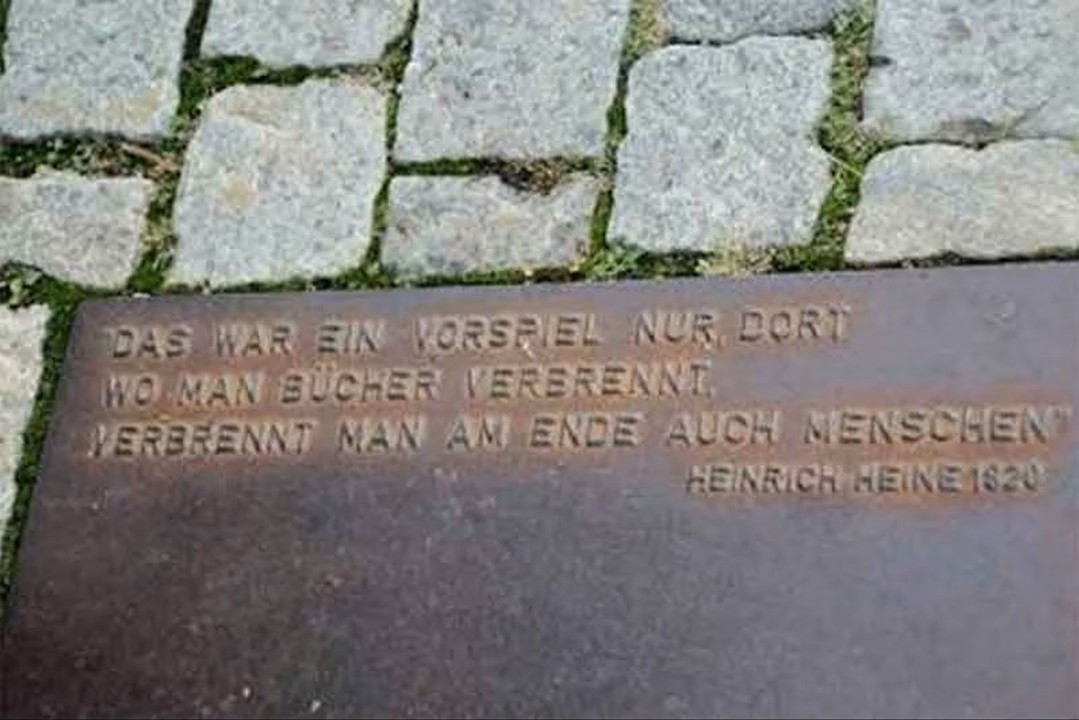 The plaque at Bebelplatz, Berlin, where the books were burnt in 1933. It carries Heine’s line from Almansor (1821): “Das war ein Vorspiel nur, dort wo man Bücher verbrennt, verbrennt man am Ende auch Menschen.” (“That was only a prelude. Where they burn books, they will in the end burn people too.”)
Nor is this a foreign disease. Buddhist texts like the Divyavadana accuse Pushyamitra Shunga of wrecking monasteries and putting a price on monks’ heads. The Chinese pilgrim Xuanzang says King Shashanka of Gauda cut down the Bodhi tree. He also writes that the Hun king Mihirakula persecuted Buddhists. The Shunga-era work at Bharhut, for one, sits awkwardly with the charge against Pushyamitra. But memory keeps a list of those who attacked ideas. We also mourn for Nalanda, which Bakhtiyar Khilji’s forces ruined around 1200 AD. Any decent person grieves over every burnt library. Can we find Charvakas’ writings today, except as presented by the opponents? Medieval Europe was no different . In 1559, the Roman Inquisition helped issue the first Roman Index of Prohibited Books under Pope Paul IV. It banned the works of hundreds of authors and shut down printers, so thousands of books were put out of reach.
It has become almost a habit for the saffron forces. Attack on books. On 29 December 2024, at the Hyderabad Book Fair, a man with saffron leanings walked up to the stall of Veekshanam, a Telugu monthly. He objected to one title, Tirupati Balaji: A Buddhist Shrine, by Jamanadas. The book argues that the great Tirupati temple has Buddhist roots. One may accept that thesis or reject it. But a book is a thing to be answered. The man filmed the encounter and the video went out on Hindutva channels.
What followed should chill us. N. Venugopal, the editor, Veekshnam, says posts and comments urged people to beat him, to douse him in petrol and burn him alive. Read that again beside Heine. First they object to a book. Then they talk of burning the man who sold it. Venugopal pointed out that the book is thirty odd years old and sold freely in many languages. Weeks later, at the Tirupati book fair, another Telugu book was torn and set alight. The pattern was already forming.
Vandalism With Impunity
Look at the rest. In March 2018, days after the BJP won Tripura, a bulldozer pulled down Lenin’s statue at Belonia. A lumpen crowd cheered. In July this year, the stone statue of Rahul Sankrityayan in Raniganj vanished overnight, and even its fourteen foot pedestal was demolished. When people met to demand it back, they say BJP workers tried to break up the meeting while police stood by. Sankrityayan was a Buddhist scholar who carried Tibetan manuscripts home to India. A man who rescued books has his statue hauled away.
Then came this Durga Puja. A public call by Suvendu Adhikari, the chief minister of West Bengal, to deny Left parties space at festive venues shows what BJP stands for. Monoply of thoughts. The CPI(M), and left paties have run book stalls at Puja grounds for decades. At Bongaon, the party says Hindu Jagran Manch members physically stopped it from setting up on 6 October. Bull dozers came. Police arrived. Saffron hooligans did the vandalism. In Dhakuria BJP-RSS activists threatened to stop setting up of CPI(M), CPI(ML)(Liberation) stalls. According to a report in Anandabazar Patrika, similar incidents have been reported from Behala and Kasba in Kolkata, Shibpur in Howrah, Naihati in North 24 parganas and elsewhere. College Street, popularly known as Boi Para or the book neighbourhood, is one of Kolkata’s historic centres of publishing, bookselling and intellectual life. In June, the Kolkata Municipality authorities verbally instructed the book stalls to vacate the area. If we remember Modi’s Red Fort threat about the Dimagi Naxals, we can understand the pattern behind these BJP acts.
A table of books is being treated as a threat. A book can be answered with another book. Only a person afraid of an argument reaches for the torch, or the bulldozer.
Heine’s warning still stands. First the books. We know what comes after.
The author is an advocate based in Guntur. The views expressed are personal.
Heine had warned them, in a way. In his play Almansor, written in 1821, he wrote that where they burn books, they will in the end burn people too. He was speaking of the Quran being burnt in Spain. He did not know he was writing his own country’s epitaph. Within a decade, the Germany that burnt his poems was burning human beings. Today those words sit on a plaque in the ground at that very square.
The plaque at Bebelplatz, Berlin, where the books were burnt in 1933. It carries Heine’s line from Almansor (1821): “Das war ein Vorspiel nur, dort wo man Bücher verbrennt, verbrennt man am Ende auch Menschen.” (“That was only a prelude. Where they burn books, they will in the end burn people too.”)Nor is this a foreign disease. Buddhist texts like the Divyavadana accuse Pushyamitra Shunga of wrecking monasteries and putting a price on monks’ heads. The Chinese pilgrim Xuanzang says King Shashanka of Gauda cut down the Bodhi tree. He also writes that the Hun king Mihirakula persecuted Buddhists. The Shunga-era work at Bharhut, for one, sits awkwardly with the charge against Pushyamitra. But memory keeps a list of those who attacked ideas. We also mourn for Nalanda, which Bakhtiyar Khilji’s forces ruined around 1200 AD. Any decent person grieves over every burnt library. Can we find Charvakas’ writings today, except as presented by the opponents? Medieval Europe was no different . In 1559, the Roman Inquisition helped issue the first Roman Index of Prohibited Books under Pope Paul IV. It banned the works of hundreds of authors and shut down printers, so thousands of books were put out of reach.
It has become almost a habit for the saffron forces. Attack on books. On 29 December 2024, at the Hyderabad Book Fair, a man with saffron leanings walked up to the stall of Veekshanam, a Telugu monthly. He objected to one title, Tirupati Balaji: A Buddhist Shrine, by Jamanadas. The book argues that the great Tirupati temple has Buddhist roots. One may accept that thesis or reject it. But a book is a thing to be answered. The man filmed the encounter and the video went out on Hindutva channels.
What followed should chill us. N. Venugopal, the editor, Veekshnam, says posts and comments urged people to beat him, to douse him in petrol and burn him alive. Read that again beside Heine. First they object to a book. Then they talk of burning the man who sold it. Venugopal pointed out that the book is thirty odd years old and sold freely in many languages. Weeks later, at the Tirupati book fair, another Telugu book was torn and set alight. The pattern was already forming.
Vandalism With Impunity
Look at the rest. In March 2018, days after the BJP won Tripura, a bulldozer pulled down Lenin’s statue at Belonia. A lumpen crowd cheered. In July this year, the stone statue of Rahul Sankrityayan in Raniganj vanished overnight, and even its fourteen foot pedestal was demolished. When people met to demand it back, they say BJP workers tried to break up the meeting while police stood by. Sankrityayan was a Buddhist scholar who carried Tibetan manuscripts home to India. A man who rescued books has his statue hauled away.
Then came this Durga Puja. A public call by Suvendu Adhikari, the chief minister of West Bengal, to deny Left parties space at festive venues shows what BJP stands for. Monoply of thoughts. The CPI(M), and left paties have run book stalls at Puja grounds for decades. At Bongaon, the party says Hindu Jagran Manch members physically stopped it from setting up on 6 October. Bull dozers came. Police arrived. Saffron hooligans did the vandalism. In Dhakuria BJP-RSS activists threatened to stop setting up of CPI(M), CPI(ML)(Liberation) stalls. According to a report in Anandabazar Patrika, similar incidents have been reported from Behala and Kasba in Kolkata, Shibpur in Howrah, Naihati in North 24 parganas and elsewhere. College Street, popularly known as Boi Para or the book neighbourhood, is one of Kolkata’s historic centres of publishing, bookselling and intellectual life. In June, the Kolkata Municipality authorities verbally instructed the book stalls to vacate the area. If we remember Modi’s Red Fort threat about the Dimagi Naxals, we can understand the pattern behind these BJP acts.
A table of books is being treated as a threat. A book can be answered with another book. Only a person afraid of an argument reaches for the torch, or the bulldozer.
Heine’s warning still stands. First the books. We know what comes after.
The author is an advocate based in Guntur. The views expressed are personal.


Comments (0)
Leave a Comment